Showing posts with label art. Show all posts

Sunday, 17 March 2013

A visit to Lyon's Museum of Contemporary Art

Sunday afternoon and it's cold and windy. Hmm. Okay then, 'let's go to the contemporary art museum' we said. So we did.

I mean, I'm no expert on contemporary art but I do enjoy going to exhibitions. My reactions range from 'what a load of rubbish! And he/she gets PAID for this??!!' to 'wow! That's really weird' to 'oh yes, I really like this exhibit (for some reason or another which I don't feel the need to delve into)'. I just like what I like and don't like what I don't like. Simple.

Lyon's Museum of Contemporary Art features three artists right now, two of which I quite liked, so here are some photos of their work, starting with the Moroccon origin artist Latifa Echakhch. Her work consists of reconstituting both a personal and collective memory of the history of Spain and Morocco, and her works are laid out like 'micro-territories', or, in her own words, "As soon as I start thinking about an exhibition I wonder what landscape I'm going to display".

No commentary from me needed, so I hope you enjoy them.


Here is the work of Chinese artist Huang Yong Ping, who explores the principles of permanence and change, the old and the new. He was a highly controversial artist in China in the 1980s, during which he founded the Xiamen Dada Group (in 1986) and burnt many of his works in front of the Xiamen museum as a protest against the prevailing and repressive cultural climate in China.


I enjoyed these two exhibitions very much, but I must say that the most beautiful sight of all to be seen in Lyon's Museum of Contemporary Art today was.....................


............my girlfriend.

Have a good Sunday night folks, full of good things.


Sunday, 13 January 2013

France should understand that there is a difference between culture and cultural heritage

Marseille, taken by me, probably whilst drinking a beer on a terrace in the Vieux Port
It would seem that the 'Marseille 2013' European Capital of Culture event and its organising committee are currently the object of bitter criticism. Not that anything could ever go smoothly in this volatile and cosmopolitan city of course.

The problem seems to be that in the run-up to the festival the city solicited proposals for cultural projects, some of which the city refused, and three refusals in particular have enraged those who submitted or supported them.

The first concerns Marseille native Marcel Petit, a famous ballet dancer, choreographer and founder of ther Marseille National Ballet who died in 2011 at the age of 87. A project in his honour was supported by Edmonde Charles-Roux, a member of the Resistance in World War Two, the daughter of a shipping magnate and the wife of Gaston Defferre, another member of the Resistance who went on to become Mayor of Marseille. He died in 1986.

Then there was the project elaborated by Marseille author and actor Philippe Caubère in honour of the poet and author André Saurès, another son of Marseille. He died in 1950. Caubère's project was also refused.

Lastly, photographer and historical photo-documentalist Antoine Agoudjian, a specialist on Armenia (he has Armenian origins) saw his idea for a project for the festival's Euro-Meditteranean workshops refused. He is bitterly angry at the decision.

I was of course sorry to read that these proposals had been refused - after all, nobody likes to see their proposals refused in any sphere of activity - but although the anger of those who worked so hard to develop their projects is understandable, I consider nevertheless that the festival committee made the right decision in each case, and here's why.

The European Capital of Culture's entry on Wikipedian sums up the event's raison d'être quite well;
Preparing a European Capital of Culture can be an opportunity for the city to generate considerable cultural, social and economic benefits and it can help foster urban regeneration, change the city's image and raise its visibility and profile on an international scale.
The key to that description is in the second half of the sentence, which puts the accent on the fact that the event can be a springboard to the future development of a city. This was put in more precise terms in a review of a 2011 book titled 'European Cultural Capital Report 3, edited by Robert Palmer, Greg Richars and Diane Dodd. The reviewer wrote that;
Bob Palmer looked back over the 25 years of ECOCs comparing it to a growing child which was conceived with a kiss between the late Greek Minister for Culture, Merlina Mercouri and French Minister of Culture, Jacques Lang. The analogy proved to give a good overview of how the ambitions and demands of the ECOC have changed over the years.
In summary, the first five years saw capital cities being awarded recognition for their importance as already established cultural capitals. Whereas from 1990, when Glasgow won the title, there was already the idea that the title could help create cultural cities - and thus the award became a torch for cities to hold for one year in recognition of their aims. Later in the proceedings, Bob Scott suggested that receiving the ECOC title was like earning a ‘scholarship’ in order to go forth and do great things.
And it is precisely that forward-looking approach which has allowed the event to survive, as it was in danger of being ossified at the beginning by its backwards-looking stance.

Nobody would deny respect to Marcel Petit, a man who introduced the word 'ballet' into the vocabulary and culture of the people of Marseille. But he died many years ago and his work is now a legacy. André Suarès was also a great man, and his books and poems were full to the brim of mature reflections upon grandeur, the quest for one's inner self and an insatiable interest for the wider and more pragmatic issues of this world. But again, he too is a part of France's proud past and although he too deserves a place in France's collective memory his work would have been out of place here. Photographer Antoine Agoudjian, at 51 years of age, is thankfully still of this world, but should he really be surprised that the committee of a modern-minded celebration of culture would prefer a younger phototographer - Kathryn Cook - who has a more contemporary and possibly more objective approach to historical events, to deal with Armenia, the history of which which she knows well?

France has always had a tendency to conflate culture and cultural heritage, and this episode demonstrates that very well. As do French university literature faculties, which are only now waking up to the fact that the old rule which meant that 'if an author is still alive he cannot be a great author' is no longer applicable. And it was also this tendency to hark back to past glories which resulted in France submitting a disastrously poor video to support its candidature for the 2012 Olympic Games. That video, full as it was of dusty and pompous references to past glories and images of fine old buildings, contained relatively few images of younger people. London's submission was much more contemporary on the other hand, it centred upon the vitality of Britain and the world's youth, and that is why the French video was largely believed to have put the Olympics committee off the idea of choosing France.

'Culture' is a fairly vague term which, in terms of countries, encompasses the globality of a country's "socially transmitted behavior patterns, arts, beliefs, institutions, and all other products of human work and thought", whereas "cultural heritage' is its legacy, a legacy of its past.

France's cultural heritage is incalculable in its scope, and it has inspired literally billions of people over the years and all over the world. But that does not give it an automatic right to sit down at the table of a modern celebration of culture today. There are times when highlighting cultural heritage is appropriate and there are times when it should make way for the modern world.

It is a real shame that the French approach to culture seems to consist of clinging onto the outdated notion that pride of place should be given to the past at the very moment when its current cultural output is getting so little support from French cultural authorities and so few opportunities to showcase itself in major events.

These events are all too often hijacked by dinosaurs of the past and their present defenders who barge noisily in and throw their airy and grandiloquent weight around in an attempt to hog the limelight at the expense of those young creators who also need their opportunity to shine.


Saturday, 12 January 2013

Lyon's mural art tribute to Mexican artist Diego Rivera

In May 2006 about 140 mural fresco and associated artists met up in Mexico City for their annual convention, and it was during this event that Guadalupe Rivera, widow of Diego Rivera, the celebrated historical, social and political artist and muralist, proposed in a speech that;

"..upon the occasion of the 50th anniversary of the death of Diego Rivera, homage shall be paid to him in Europe by the mural painters of Cité Création."


The result can be seen below in a series of photos I took today here in Lyon of the spectacular mural paintings created in Rivera's honour by Lyon-based mural art specialist association Cité Création. The work consists of three mural paintings on the walls which enclose three sides of a public square, just next to a small park. The central element is this one, applied to the side wall of a building.


Next to this work and on a smaller wall at 90% to it is this rectangular mural.


And the building wall opposite the first one is host to the third and final element.


Each individual panel on the two building wall paintings, as well as the painting on the long rectangular wall, tells a story of a historical event era or phenomenon that Diego Rivera had adressed during his lifetime of painting. To help visitors, Cité Création also painted a pictorial and numbered guide for each wall, accompanied by explanatory text. Here is an example.


For those who don't read French however, I took a few close ups of individual panels and translated the descriptions of some of them. Here is a depiction of a major event in Mexican history. It is on the bottom left of the principal wall. 'Conquest and Christianisation. Scenes of religious conversions, forcible baptism or death for recalcitrants."


Next to it can be seen "The arrival of Hernan Cortés. The priest Pedro Alvarado, nicknamed 'the bloodthirsty redhead', gives back to Cortés the gold he has plundered..."


Over on the opposite, 'yellow' wall is a detail from this painting, bottom left, of "Workers. During the production phase of the Ford V8 engine at the Detroit factory."


On the bottom right of that same wall can be seen this almost Dantesque vision of "Carnival. Denounces the cupidity and corruption which reigns within Mexican politics. Diego Rivera caricatures certain governing figures as animals."


Finally, here's a detail from the rectangular wall. Unfortunately though, dear reader, I forgot to take a photo of the texts for that wall so I'm afraid we shall just have to wake up our neurones and use our imaginations to conjure up our own versions of what may be happening.


That homage to Rivera is situated less than a kilometre from where I am sitting, and it is just one of the dozens of other jumbo-sized mural paintings which are to be found all over Lyon and the surrounding areas (I took some photos of another one, and you can see them here). They were all painted by Cité Création. The association is an internationally-renowned organisation which employs dozens of painters in Lyon alone and it has painted or commissioned almost 600 mural paintings in countries all over the world.

But Cité Création doesn't just 'do paintings on walls', they fulfil a vital need here in Lyon and other major cities. City life can be exciting, but cities can also be soul-destroying at times, so these works - and it is difficult not to spot at least one during a random walk through the city - act as an effective antidote to some of the drab and depressing sights which are to be seen in any city. They are a colourful, inspiring, uplifting and informative mix of history and aesthetics. Every single mural tells a story of real people and events or imagines a better future.

They are the material of dreams.

Sunday, 23 December 2012

Empty Room


This photograph was taken by the highly symbolic and artsy-farty pretentious but oh-so-morally-tragico-jubilant self-flagellating genius and modern master of post-fururist Surrealism an' 'ighly-clevah'-an' all that photographer, the friend with whom I am investing (as a minor partner) in a two-house property in the country (more here). It needs renovating and she borrowed my small digital camera today before going there to see how the work was going and plant I-don't-no-what kind of tree with her mother. Or something.

What you see here is a photo she took of the inside of her place, stripped down to basics. Waiting for the renovations to begin.

If Andy Warhol or someone had taken this photo they'd have been paid a fortune for it.

Worthless and wonderful. Just as good photos should be.

Sunday, 2 December 2012

'Tis Pity She's a Whore at Lyon's Célestins theatre

This play, written by Jacobean dramatist John Ford in about 1630 and published in 1633, is one of the most controversial pieces of theatre in the history of British literature. Passionate and tragically melancholic, 'Tis Pity She's a Whore is a penetrating psychological study of incest which relates the ill-fated relationship between a brother and sister whose refusal to obey society's rules and the religious and moral dogma of the time will have tragic consequences not only for themselves but for many others too.

I went to see it's last performance in Lyon yesterday evening at the Célestins theatre, which is one of the most beautiful theatres in France and, indeed, the whole of Europe. First built in the late 1700s it was rebuilt after a fire and inaugurated in 1877. Here's a photo of it I took yesterday before the play began.

The Célestins theatre, Lyon France

As the theatre has French technical staff and the play's actors and technical staff are mainly British I was asked by the theatre to work as an English-French interpreter for them. My job was to be on hand in case the French and British set, lighting, sound and other staff needed linguistic help to explain how to unload the set and props, set it all up, and explain the (very complex) costume changes to the theatre's French wardrobe staff, who would be helping the actors during performances.

I am by no means a theatre critic so I'll keep this short, but I would like to say a few words about last night's performance. It was quite simply stunning. This English-language production came courtesy of international theatre company Cheek By Jowl and it was directed by Declan Donnellan. Morbid, full of "gallows humour" as one of the actors put it to me after the performance, violent, tender, threatening and full of foreboding, my eyes were riveted to the action from start to finish. Incest is a difficult subject to work with even today, but I was pleased to see that Donnellan has chosen a deliberately stark and uncompromising approach which I find both daring and creative.

The Célestins being a classical theatre designed to help voices resonate, the dialogue was both percussive and seductive due to the excellent voice projection of the actors in this cast. There are many powerful moments and performances in this play, but if forced to mention just one I would say that I was particularly struck by the compelling and authoritative presence of Hedydd Dylan's 'Hippolita'. In one scene her mood changed from vicious to ironic to loving to threatening and back again in less than a minute. She was breathtaking. The audience's applause at the end was a fitting tribute to this excellent production and they offered the cast no less than seven encores, which is something I, who have seen many plays here, have rarely seen before.

I had to go onstage afterwards in case they needed me during their preparations to take down the set and load the truck, but was pleasantly surprised to see that the two crews had developed such a good understanding of each other over the five days they had worked together that I was rarely called upon.

So off to the theatre's bar I went, where I chatted with a couple of the actors and happened to bump into Hedydd Dylan. When I told her what I thought of her performance she looked almost surprised. "Really?" she said, "I thought I was a little under par because I have been feeling rather tired today."

It had been a privilege to be able to add my tiny contribution to this play's five-day run in Lyon and both the crew and the performers were friendly, open, chatty and elegantly modest. It had been a pleasure to meet them.

I climbed into my taxi to go home and on the way I remembered Dylan's words and thought to myself "well if that's what she's like when she's tired, she must be devastating when she's on top form."

To say that this play comes highly-recommended would be an understatement.

('Tis Pity She's a Whore' will be playing in Nantes in a few days and if you happen to live in the area I would strongly recommend that you go and see it. More info on Cheek By Jowl's website.)

------------------------------

Here a few more photos of the theatre;

The Célestins theatre, Lyon France

The Célestins theatre, Lyon France

The Célestins theatre, Lyon France

Excellent evening to one and all.

Saturday, 24 November 2012

Photos and video of 'La Fresque des Lyonnais'

This jumbo-sized fresco can be seen down by the river Saône in the Martinière area of the town centre here in Lyon. As its name suggests it was painted in honour of the people and culture of Lyon and it attracts visitors all year round.

The six-storey fresco was painted by Cité Création, a local association which specialises in wall painting and mural art. Based just up the road from where I live, Cité Création has created over 580 building-sized frescos all over the world, including dozens here in Lyon alone.

Of all the frescos they have done in Lyon however this is one of the biggest favourites with the locals. It showcases the city's literary traditions and culinary excellence as well as some of its most famous personalities.

Here's a video of it I took this afternoon, followed by photos of a few details. There's an amazing amount of detail in there, particularly given its size. Everything you see has been painted. Impressive stuff I say..


Some of the better-known names in local produce production

If you ain't ate 'ere, you ain't ate nowhere baby

Abbé Pierre. Born in Lyon, he was a Capucin Catholic priest, a war resistant and an influential campaigner for the poor and homeless


Most people here quite rightly detest the stuff, but still, we drink it once a year to support this local industry

Lyon's literature. I love this detail in particular because the reflections in the window look so real...

A painting of a mural artist painting a mural

Wanna fresco on your garden wall? Give 'em a ring...

...and while you're at it say hello from the English guy in Gerland. I have visited their offices and facilities several times and they are always willing to discuss their work.

I'll be posting more frescos by Cité Création in the future, and for anyone interested in mural art and wall painting their site is well worth a visit. There are photos galore there of most of their works from all over the world.

Right. It's time for an apéritif so see you soon and be good. If possible. :)

Saturday, 10 November 2012

A drizzly day walking tour of Lyon city centre as seen by its statues

Yup, it's been raining and drizzling on and off all day here in Lyon. Still, it has been warm too so I decided to take a stroll around the city centre and take pictures of the statues there.

Not each and every one, because there are dozens of them including many modern ones too, just some of the older and better known ones which are pointers to the city's history.

So it's off to the south of the city centre by bus and to Perrache railway station before heading out and into the large public square in front of it. There are three statues there, including one of Marianne, who, as you can imagine, reigns from high above the other statues and us mere mortals.


The others may be smaller, but they are no less pleasing to look at. Here's a rather stern statue of someone but there's no information on who the person is and I can't tell from looking at it. Any ideas anyone?


But my favourite by far is this one. It's a small, simple, sobre, unassuming and moving tribute to those who died at Verdun in the First World War. Enclosed within a small memorial garden, it has been tastefully and discreetly isolated by an elegant 50-centimetre fence.


Perrache station is on the edge of the traditionally bourgois quarter of Ainay and there are quite a few statues there. One of them is in honour of André-Marie Ampère (20 January 1775 – 10 June 1836), the French physicist after whom the international measuring standard for electric current - the ampere - was named. I didn't take a close-up of him because I thought you might like to see the whole structure..


At the heart of Ainay lies a charming little square.....


....in the centre of which you can contemplate this elegantly slender yet imposing creation.


A little further north is one of the tallest yet least known statues in Lyon because it is discreetly situated in a small square right next to the Rhône river which sees relatively little pedestrian traffic. It's in honour of Antoine Gailleton, a famous doctor and native of Lyon who happened to be with French president Sadi Carnot in 1894 when Carnot was stabbed by an Italian anarchist. Gailleton tried to save his life but his efforts would unfortunately be in vain..


Lyon's most famous statue of all (but not necessarily the best in my opinion) is to be found in the third-biggest pedestrian public square in Europe. It's even bigger than Red Square. This square is the true centre of the city and the statue of Louis XIV is right in the middle of it. It's the traditional meet-up place for lovers and friends who are going out for the evening and everyone here knows what you mean when you say "okay, I'll meet you under the horse's tail at half-past seven."

(I know you can't see much detail in this photo (dunno what happened there) but I quite liked the ominous 'shadow' effect against the sombre clouds.....)


And in case you were thinking of climbing up to say hello to the King you should know that he has deployed a couple of rather fearsome-looking guards below him, at the base of the plinth. You shall climb at your own risk and peril....


A side-street off Bellecour leads onwards to the Place des Jacobins and one of the most beautifully proportioned and situated statue-fountain structures to be found in the whole of France or anywhere else for that matter. It has just been cleaned and the effect is stunning. Here are two views of it.


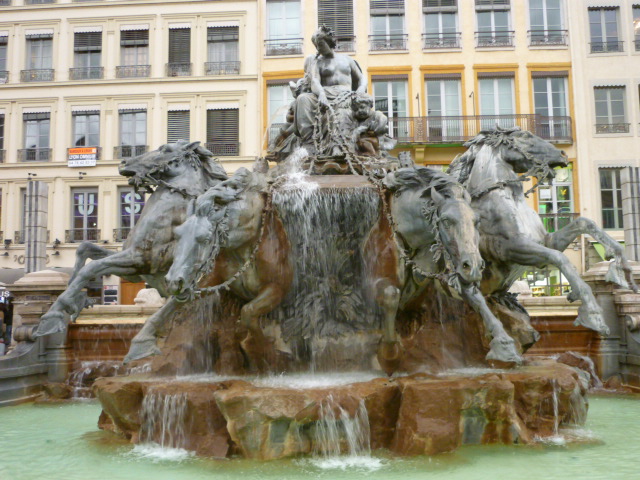
So now I have walked the whole way across Lyon city centre to the other end and this is the statue which stands before the City Hall. It's an extravant explosion of expression. But that's not surprising really, given that it was created by Frédéric Auguste Bartholdi, the man who also happened to design the Statue of Liberty......


It's dark outside as I type, but most of those statues are not in the dark, they have been tastefully lit up for the pleasure of those who are strolling the streets of Lyon. I intend to take another series of these statues at night, when they take on a whole new aspect.

Meanwhile, have a good evening, full of good things.

Fripouille

Thursday, 8 November 2012

Lyon: The Place des Terreaux and the gardens of the Fine Arts Museum

Lyon's Fine Art museum is one of the largest in France and Europe. A massive four-sided construction surrounding a large courtyard/garden, it is a magnificent XVIIth century building and its 70 spacious collection rooms and areas are home to many fine collections of paintings, sculpture, artefacts and other art forms dating from antiquity up until modern times.

The museum is situated in the heart of the city centre and one of its facades constitutes one whole side of the city's most beautiful public square, the Place des Terreaux. This photo can only take in half of its length.

Musée des Beaux-Arts, Lyon


The square is dominated by the Town Hall, a sumptuous and imposing building which is well worth a visit in its own right. It was built between 1645 and 1651, although it has been renovated since. 

Hôtel de Ville, Lyon


One of the other sides is occupied by this elegant and wildly extravagant statue - the Bartholdi Fountain - which was sculpted by Frédéric Auguste Bartholdi in 1889, just a few years after he had designed the Statue of Liberty.


La Fontaine Bartholdi, Lyon


You can get a better idea of how beautiful the Place des Terreaux is by going here. Click left, hold, and move around on the moving panoramic video.

If ever you visit the Fine Arts museum, you will go through one of the entrance gates before crossing over one of these gorgeous cloisters....


...and emerging into the gardens.....


...at which point you shall instantly forget that you are in the centre of a major city. You are now in an oasis of peaceful calm with statues dotted all around amongst the trees, attractive flowerbeds and pathways, and there are benches everywhere to sit on in order to relax and take it all in. These statues are by renowned sculptors from well over a thousand years ago up to the 18th century, and it is not uncommon for first time visitors (and even regulars) to stop and spend some time in the gardens either before or after (or both?) entering the museum itself....

I have chosen not to describe them and their creators because I thought they didn't need my words, they just need to be looked at, although I shall be only too pleased to offer information on them in comments or in answer to email.

I hope you enjoy them and may I wish you an excellent evening.


--------------------