Tuesday, 13 November 2012

Mohammed Merah: a sordid trail which leads from from terrorism to a reality which France ignores..

Mohammed Merah
The name of Mohammed Merah first hit the world's press in March of this year when the self-styled terrorist became the prime suspect in the killing of three off-duty French soldiers and four Jewish children and staff at a Jewish school in southern France.

He would be shot and killed by a police sniper in his hometown of Toulouse after a 30-hour siege and a shootout.

His story would normally have ended there and his name would eventually have been forgotten by all but his family and those of his victims but it was not to be. Since the killing of Merah the French press has continued to focus on his family, largely at their demand, and their drip-feed of revelations have given a horrifying insight into how Merah became a killer. The wildly differing reactions of various members of his family after the killings have painted a somber picture of their lives and they offer a revealing insight to she spread of Islamist/Salafist tendencies in France. They are also a tragic testimony to the harsh realities of life within France's Muslim community.

Many details of Merah's past became known soon after his death. He was brought up by his divorced mother in a climate of violence, he had "a violent profile from childhood and behavioural troubles", and he had been arrested and jailed several times for relatively minor offences. He once tried to commit suicide by hanging and French intelligence agency the DCRI had been tailing him for three years because of his connections to radical Islamic groups.


His older brother Abdelkader was also followed by intelligence agencies and he was arrested shortly after his death. Abdelkader now faces preliminary charges of 'complicity in murder and conspiracy to commit acts of terrorism in connection' with Mohammed's killing spree.

Shortly after that their father began legal action for 'murder with aggravating circumstances' against the police units who were involved in the siege and killing of his son. Press rumours began to speculate upon the possible existence of a sharp differences of opinion on Merah's actions within the Muslim community.

The affair had just begun to disappear from the front pages when a major development instantly propulsed it back into the spotlight. Mohammed Merah has a second brother, Abdelghani, and he recently announced the upcoming release of a book in which he relates his side of the story. Called 'My Brother the Terrorist', it makes for chilling reading.

He firmly condemns his brother Mohammed for his actions and goes on to allege that his family played a major role in Mohammed becoming an Islamic radical before denouncing "the hate, the racism and the antisemitism" which he claims were omnipresent within the family. He criticises the "indecency" demonstrated by his father when he accused the police of wrongdoing and  relates how Abdelkader insulted his girlfriend because she was Jewish and told him to "leave your dirty Jewish girlfriend." Abdelghani did not do so however and his enraged brother stabbed him seven times. Abdelghani also accuses Abdelkader of being instrumental in Mohammed's conversion to radical Islam.

He accuses his sister Souad of having similar tendencies and that she had told him several times that she was "proud of Mohammed and the crimes he committed", adding that she was proud that he had had the courage to become a Moujahidin.

The book was a bombshell and Souad in particular was outraged by it. Which is why she met with him and other members of the family in a park - where they thought they would not be seen - to discuss it. But they were seen, by a television crew from French TV station M6. They secretly filmed the whole scene and Abdelghani carried a microphone which recorded the conversation, although precise details of how this operation was mounted remain sketchy.

Souad was heard to say "I think well of Bin Laden and at least the Salafists are actually doing something." She goes on to say "I detest the Jews, all those who are massacring Muslims."

This led to more major headlines of course, and a Parisian judge immediately ordered the opening of a preliminary inquiry in view of charging her with 'apologism for terrorist acts.'

Abdelghani Merah has subsequently revealed that he has received "threats" from his family and that his mother has threatened to commit suicide in front of his own child if he allows the book to be published.

That is the sad and tawdry tale of the Merah affair so far, more shall surely follow, and there are major lessons to be learned from it.

Moderate Muslim clerics and the vast majority of the Muslim community deplored Mohammed Merah's actions, just as they deplored his father's decision to begin legal action against the police and have deplored Souad's opinions. They are also worried that the constant drip of insights into how Salafism spreads amongst Muslims will reflect badly on the Muslim community as a whole.

But their sentiments, if understandable, are misplaced. A large majority of French citizens know full well that the vast majority of French Muslims and the wider Muslim immigrant community are totally opposed to terrorism in the name of Islam, that they categorically oppose Salifism and radical Islam in all its forms, and that they wish to lead peaceful lives.

The irony of the situation is that the very fact that members of Merah's family are washing their dirty laundry in public should be seized upon as an opportunity to better understand not only how Salifism recruits in France, but also as a pointer to what should be done by French society to prevent Muslim children being brought up to hate and despise others to the point of wanting to kill them.

The truth is out in the open now and it is up to French society to face up to its implications as well as its duty to better integrate its Muslim communities. Terrorists deserve no quarter and intelligence efforts to track them and stop them acting should be intensified, but - and more importantly - it is time that France offered its Muslims the possibility of a better future.

Sunday, 11 November 2012

France debates the 'Nutella tax'

Brown stuff in a jar
The renowned qualities of French cuisine go a long way towards explaining why the French are 'patriotic' eaters who sometimes find it difficult to adapt to foreign food. There are two major exceptions to this general rule however, the first being the massively popular McDonalds, which I wrote about here, and Nutella, which is an equally popular chocolate hazelnut spread.

So it's not surprising that there have been dozens of articles in the French press recently about government plans to impose a massive 300% hike on palm oil, which is one of Nutella's main ingredients.

Nutella is an Italian product which was first marketed in 1963 by Italian company Ferrero, but it has been produced in a subsidiary here in France for years in order to keep up with French demand. And demand there is. It has become such an intrinsic part of growing up that I imagine that many French people would say it was actually French.

I don't know what percentage of children don't like chocolate but it is surely very low, and that is why almost every French child slathers it onto bread or toast for breakfast before heading off to school. They eat it during their afternoon snack as well. But the appeal doesn't stop there because many of those children continue to eat it long after they have grown up. It can be found piled onto pancakes (often accompanied by sliced banana) poured into cake recipe bowls, and it is present in many desserts. Few French homes do not have a jar of it in the cupboard, and my god daughter would go ballistic if ever I forgot to make sure I had some in stock for when she comes to stay.

The problem though, is that about 20% of Nutella consists of palm oil, a product which is known to have a very high saturated fat level and which is suspected of contributing to obesity and even heart disease. Also, the widespread use of palm oil in food has led to deforestation in Malaysia, Indonesia and elsewhere in order to create new plantations of the oil palms from which it is derived. All of this has been used by the cash-strapped government as a stick to beat it with and try to introduce a 300% tax on it. The proposal has been approved by the Senate and will now be debated in Parliament.

There has been much public debate about the proposal too, and it was even defended by a nutrition expert in one article. Her argument was 'why pick on Nutella? After all, palm oil is used in many foodstuffs and even in schools.' She says that we cannot do without it but there's no problem if we don't eat too much of it. Well that's not easy given that it is used in many bakery products, biscuits, crisps, many kinds of processed food and low-priced restaurants.

This reminds me of a....oh, never mind...


That this tax should lead to so much press coverage and debate is understandable of course, given Nutella's enormous popularity, but despite all the hue and cry the bottom line is that the tax would only lead to an almost negligeable price rise of about €0.06 per kilo.

Still, all the debate and articles will have had one positive side to them, and that is that they have served as a reminder to the public that a balanced and healthy diet is important.

So, should we be allowing our children to eat Nutella? Whatever the answer it pays to do some research, and one enterprising young Frenchman has done just that in a startling manner. Here's a video of his simple experiment, which was cheekily put to the same music that Nutella uses in its ads. Be warned, the result of his experiment is NOT a pretty sight. I don't happen to like Nutella myself and this video is certainly not likely to make me change from my usual Weetabix, banana and milk anytime soon.

Bon appetit (?)


Saturday, 10 November 2012

A drizzly day walking tour of Lyon city centre as seen by its statues

Yup, it's been raining and drizzling on and off all day here in Lyon. Still, it has been warm too so I decided to take a stroll around the city centre and take pictures of the statues there.

Not each and every one, because there are dozens of them including many modern ones too, just some of the older and better known ones which are pointers to the city's history.

So it's off to the south of the city centre by bus and to Perrache railway station before heading out and into the large public square in front of it. There are three statues there, including one of Marianne, who, as you can imagine, reigns from high above the other statues and us mere mortals.


The others may be smaller, but they are no less pleasing to look at. Here's a rather stern statue of someone but there's no information on who the person is and I can't tell from looking at it. Any ideas anyone?


But my favourite by far is this one. It's a small, simple, sobre, unassuming and moving tribute to those who died at Verdun in the First World War. Enclosed within a small memorial garden, it has been tastefully and discreetly isolated by an elegant 50-centimetre fence.


Perrache station is on the edge of the traditionally bourgois quarter of Ainay and there are quite a few statues there. One of them is in honour of André-Marie Ampère (20 January 1775 – 10 June 1836), the French physicist after whom the international measuring standard for electric current - the ampere - was named. I didn't take a close-up of him because I thought you might like to see the whole structure..


At the heart of Ainay lies a charming little square.....


....in the centre of which you can contemplate this elegantly slender yet imposing creation.


A little further north is one of the tallest yet least known statues in Lyon because it is discreetly situated in a small square right next to the Rhône river which sees relatively little pedestrian traffic. It's in honour of Antoine Gailleton, a famous doctor and native of Lyon who happened to be with French president Sadi Carnot in 1894 when Carnot was stabbed by an Italian anarchist. Gailleton tried to save his life but his efforts would unfortunately be in vain..


Lyon's most famous statue of all (but not necessarily the best in my opinion) is to be found in the third-biggest pedestrian public square in Europe. It's even bigger than Red Square. This square is the true centre of the city and the statue of Louis XIV is right in the middle of it. It's the traditional meet-up place for lovers and friends who are going out for the evening and everyone here knows what you mean when you say "okay, I'll meet you under the horse's tail at half-past seven."

(I know you can't see much detail in this photo (dunno what happened there) but I quite liked the ominous 'shadow' effect against the sombre clouds.....)


And in case you were thinking of climbing up to say hello to the King you should know that he has deployed a couple of rather fearsome-looking guards below him, at the base of the plinth. You shall climb at your own risk and peril....


A side-street off Bellecour leads onwards to the Place des Jacobins and one of the most beautifully proportioned and situated statue-fountain structures to be found in the whole of France or anywhere else for that matter. It has just been cleaned and the effect is stunning. Here are two views of it.


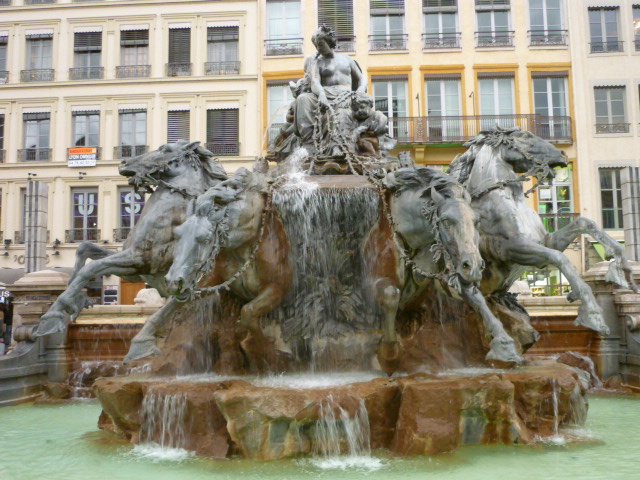
So now I have walked the whole way across Lyon city centre to the other end and this is the statue which stands before the City Hall. It's an extravant explosion of expression. But that's not surprising really, given that it was created by Frédéric Auguste Bartholdi, the man who also happened to design the Statue of Liberty......


It's dark outside as I type, but most of those statues are not in the dark, they have been tastefully lit up for the pleasure of those who are strolling the streets of Lyon. I intend to take another series of these statues at night, when they take on a whole new aspect.

Meanwhile, have a good evening, full of good things.

Fripouille

Friday, 9 November 2012

The platform at my local Metro station is 40,075 kilometres (24,901 miles) long

When I go down the escalator and onto the platform at my local Metro station I am on the beach in Nemuro, a mid-sized town on the extreme west coast of Hokkaidö, Japan. If I want to walk to the other end of the platform though I first have to swim across thousands of miles of vast and empty Pacific Ocean....


....before I reach land. I'm in Seattle, so I get behind the controls of a plane and fly over America and its myriad spectacular mountains, brooding and dangerous deserts, bustling metropolitan big cities, towns and villages.


I decide to push a little further north and pick up a full load of fuel in Montreal (the pretzels aren't much good there) before taking off again with a flight plan which will take me over Newfoundland's black and bleak terrain and out into the freezing northern Atlantic towards Europe.


Midway over the vast blue Atlantic however I see something unusual. I can hardly believe it's there so I rub my eyes, but, incredibly enough, it's clear that I am flying over what looks like a Metro station information board with an emergency phone next to it and a Metro map after that. The whole thing seems to cover an area of about 1500 miles by1750. Hmmm.. Maybe my oxygen levels are low and I'm starting to become delirious.


So I descend to 11,000 feet in order to be able to rely less on pressurisation and it's just as well. I have drifted off my original course and instead of flying over Scotland I am just off the coast of France. Time to stop for a rest in Paris and eat a good meal at Fouquet's.


Then it's off I go, heading slightly south over Eastern Europe. It's an area which I, like many other Western Europeans, don't know much about. I must make a point of going there one day. But not today so I press on over the northern expanses of the Black Sea and the Caspian Sea.....


....and along the borders of Kazakhstan and Turkmenistan where it's getting dark before realising that if I stay on this course I'll soon be over Afghanistan and Pakistan. In the safety interests of all my passengers, which means me, who does not want to finish the day being either shot down by an F18 or executed by the Taliban I climb to 39,000ft and steer well clear....


Over the forlornly beautiful Mongolian Steppes I go and I remember that I have always wanted to go trekking there. That will have to wait I suppose, but those windswept swathes of land have existed  almost unchanged for hundreds of thousands of years and more so I am sure they will still be there if ever I were able to go.

Ever onwards I go high over the sparesly dotted lights of the towns and cities of China. In some places there are lots of lights, but most of it is forbiddingly dark. What does that mean? I do need fuel though, and decide to half-fill during a quick stopover in Beijing. After taking off again I keep North Korea well off to the south. I can just see it far beyond the tip of my right wing, and that's close enough thank you.


And then I finally find myself over the calm waters of the Sea of Japan, with less than 90 minutes to fly before landing where I started, in Nemuro, the mid-sized town on the extreme west coast of Hokkaidö, Japan from which I started my voyage. The whole trip, with its changes of course, is the equivalent of flying round the world along the Equator, which is 40,075 kilometres - or 24,901 miles - long.


Each time I go to my local station and wait for a train I either walk along the platform whilst looking at the world map and go on an imaginary voyage, or I stand still and study a particular region of the world and concentrate on it. This evokes strong imagesin me and I can almost feel like I'm in the places I am looking at on the map.

So even if the trains are running slow I never notice the time go by, engrossed as I am by the map and what it evokes. I can be anywhere in an instant. So my train is two minutes late? Five minutes late? Who cares frankly. I have better things to do because although Jules Verne was able to go 'Around the World in 80 Days', I can do it in less than 30 seconds........

Thursday, 8 November 2012

Lyon: The Place des Terreaux and the gardens of the Fine Arts Museum

Lyon's Fine Art museum is one of the largest in France and Europe. A massive four-sided construction surrounding a large courtyard/garden, it is a magnificent XVIIth century building and its 70 spacious collection rooms and areas are home to many fine collections of paintings, sculpture, artefacts and other art forms dating from antiquity up until modern times.

The museum is situated in the heart of the city centre and one of its facades constitutes one whole side of the city's most beautiful public square, the Place des Terreaux. This photo can only take in half of its length.

Musée des Beaux-Arts, Lyon


The square is dominated by the Town Hall, a sumptuous and imposing building which is well worth a visit in its own right. It was built between 1645 and 1651, although it has been renovated since. 

Hôtel de Ville, Lyon


One of the other sides is occupied by this elegant and wildly extravagant statue - the Bartholdi Fountain - which was sculpted by Frédéric Auguste Bartholdi in 1889, just a few years after he had designed the Statue of Liberty.


La Fontaine Bartholdi, Lyon


You can get a better idea of how beautiful the Place des Terreaux is by going here. Click left, hold, and move around on the moving panoramic video.

If ever you visit the Fine Arts museum, you will go through one of the entrance gates before crossing over one of these gorgeous cloisters....


...and emerging into the gardens.....


...at which point you shall instantly forget that you are in the centre of a major city. You are now in an oasis of peaceful calm with statues dotted all around amongst the trees, attractive flowerbeds and pathways, and there are benches everywhere to sit on in order to relax and take it all in. These statues are by renowned sculptors from well over a thousand years ago up to the 18th century, and it is not uncommon for first time visitors (and even regulars) to stop and spend some time in the gardens either before or after (or both?) entering the museum itself....

I have chosen not to describe them and their creators because I thought they didn't need my words, they just need to be looked at, although I shall be only too pleased to offer information on them in comments or in answer to email.

I hope you enjoy them and may I wish you an excellent evening.


--------------------

Wednesday, 7 November 2012

French politicians could learn a lot from the fun side of Obama's win

"That you Joe? I'm jus' chillin' out an' doin' a J. You?"
As the curtain comes down on the American presidential election it's time to congratulate Obama and offer commiserations to Romney. The battle for the White House, like those for power in France or any other country, had its share of underhanded tactics and unhealthy insinuations from both camps, but American elections also contain another element - fun - and fun is sadly absent on the French political scene.

This was not lost on Marie Brunerie, a French  specialist on American politics who posted an interesting article on the Nouvel Observateur's Plus section this morning. And "fun" was at the top of her list of cultural and political differences between the French and American ways of conducting politics.

Brunerie regrets that French politics are so relatively dreary and lacklustre and that autoderision is non-existent. There were many amusing moments during the American campaign and she chose to illustrate this by mentioning both Romney and Obama's often amusing and light-hearted appearances on late night TV shows such as Jay Leno's Tonight Show, David Letterman's Late Show and Jimmy Fallon's Late Night show, during which Obama, who was named 'Slammer-in-Chief' for the evening, and himself slow jammed the news with the resident band.


Now I'm not a betting man but I'll gladly bet my best bottle of Bordeaux that we won't be seeing anything like that in France for a long time to come. Can you imagine Hollande or any other French politician hangin' out an' havin' fun just days before an election? And how about the witty comments that both candidates came up with during their back-to-back speeches at the Al Smith Dinner at the Waldorf Astoria?

Brunerie is not the first French commentator to lament the lack of warmth and humour in French politics of course, and the glaring fun quotient difference between French and American politics and elections jumps out of screens and pages and lands in the lap of any honest French journalist or citizen who follows American elections.

If wit was....food, politics is a banquet in America and it is stale bread and water rations in France, a country where poiliticians think fun means sarcasm, mockery, derision and insult. This is a country in which dozens of magistrates and judges paid for by taxpayers have to constantly deal with an average of a couple of dozen slander and libel cases which have been brought by politicians against other politicians.

I am reminded of the particularly graceless and tasteless remark which NIcolas Sarkozy aimed at François Hollande during their televised debate between the two votes at the last election. Referring to the condescending 'Mr joker' nickname given to Hollande by his Socialist rivals he said "this isn't a joke competition." And Hollande himself seemed to abandon any humour he may have had before he became a candidate when he lost a lot of weight to avoid being the butt of cruel jokes about his portly appearace.

He did this because he realised that humour and being relaxed are not winning tactics in French politics and he went on to embrace his new nickname of 'Mr Normal', earned because his revised and much more seriously sober demeanor was welcomed by French voters who had had enough of Sarkozy's more brash and bling-bling style.

His political advisors had persuaded him that the French want their presidents to be seen to be above the fray and conform to the Gaullian and Regalian image of being "the first among all French citizens." One even said that being president involved "an almost Jupiterian dimension. And Jupiter doesn't laugh, he rains fire down upon the world."

And who indeed will ever forget the mocking tone used by François Mitterand during his debate with Jacques Chirac during the 1988 presidentail race? He responded to an opinion offered by Chirac with the cheap and juvenile jibe "you are absolutely right Mister the Prime minister." Then there was the abysmal excuse for a debate between Front Nationale leader Marine le Pen and left-wing loudmouth Jean-Luc Mélenchon. A litany of insult and ignominy, I related it here.

But it isn't only during campaigns that French politicians lack humour and grace. It's the same story when the battle is over and the guns go silent. Compare Ségolène Royal's petulant foot-stamping tantrum call for the French to take to the streets to protest on the evening she she lost to Sarkozy in 2007 to the elegance and generosity of John McCain's speech after he was beaten by Obama in 2008. The same contrast is to be seen between Sarkozy's sulky take-my-ball-home 'that's it I'm quitting politics' reaction after losing to Hollande and Romney's gracious concession speech yesterday after he had learned that he had lost. But first prize for the worst ever bad loser in modern French politics goes to Giscard d'Estaing. Here is the ludicrously pompous and insulting manner with which said "au revoir" to the nation, got up, turned his back, left the room, and left a contempt-laden empty chair behind him after losing his presidency to Mitterand in 1981.


Cynics and weary sneerers will doubtless say that all the wisecracking and courtesy is a smarmy put-on and that it is all designed to garner votes. They are right in some repects and in absolute terms of course, but it's not because someone doesn't like someone at work because they beat them at badminton that they cannot be civilised and polite when they find themselves in the same room. That's not hypocrisy, it's a way of ensuring that whatever people's differences, it is important that participation in society - and politics - should be about mutual respect as well as winning, and losing, graciously.

Besides, those same sneerers and cynics are also the first to complain about the deleterious manner with which politicians conduct their debates. They cannot have it both ways.

I would like to believe that despite the cut-and-thrust and high stakes in politics it should still possible for French politicians to do much more to respect the institutions they represent, respect each other, respect themselves and, most of all, respect the public, who are entitled to more than the name-calling, petty insults and childish slanging matches which replaced political debate here long ago.

And a good way to start would be for them to take themselves less seriously. Politicians here should be setting an example when it comes to debating issues of national importance and the occasional dose of humour would help to grease the wheels.

So c'mon François, you're the president so why don't you set the ball rolling? How about a dose of autoderision to help you explain your U-Turn on VAT? After all, like Obama in his first debate, you loused up so 'fess up. Maybe you could wear a grass skirt and a tiara to work tomorrow? How about a quick quip about the end of your presidential honeymoon? Give us anything that will put a smile on our faces for once.

After all, god and his dog knows we have precious little to smile about right now....

Tuesday, 6 November 2012

War! What is it good for? Absolutely nuthin'!

That song hits the nail right on the head. I was reminded of that a few weeks ago when I first watched the video below, which includes much of the amateur footage of the last few sordid hours of Mutassim Gaddafi's life after he had been captured by the rebels towards the end of the Libyan War, as well as the aftermath of his execution. I have watched it a couple of times since. The text overlays, which are thankfully not too overly prevalent, make clear that the video was put together by its compiler in an attempt to praise Mutassim and serve as a kind of testimony to him. But all that was completely irrelevant to me and the longer the video went on the more I ignored the words because the powerful juxtaposition of image, music and the offhandedly bestial anger and vengeance of the war-hardened voices and the pitifully oppressing banality of what was happening gave me a completely different impression of what I was seeing which drowned out all ideological, political and other petty earthly considerations.


My impression consisted of a mixed bag of emotions. Intense sadness at the tragic futility of war and the pointless cruelty of it all, helplessness in the knowledge that human beings fight and kill each other and that they always have done and probably always will, and - perhaps most of all - humbled awe at the fact that we are all, even the most powerful among us, nothing but tiny little specks of near-nothingness in the bigger picture who are all destined to die and eventually disappear without trace from the history of the Universe.

This video reminded me that death is The Great Leveler who always wins out in the end, despite all the fleeting and ultimately futile power games that human beings play…