Showing posts with label law. Show all posts

Wednesday, 24 April 2013

Hollande says no to a 'social amnesty' for trades unionists found guilty of crimes

A badly organised office
Back in February, the French Senate endorsed an insane law proposal submitted by the Communist and other hard left parties for a 'social amnesty' for trades union strikers who vandalise property and commit various other acts of hooliganism in the name of their cause. This law, although it would have excluded those found guilty of physical violence, would have ensured that all those who have been found guilty of other strike and demonstration-related crimes since 2006 would have had their sentences overturned. Pending cases and those on appeal would have been dropped.

The Senate was able to vote in favour of sending it to parliament for a vote because all left-wingers supported it, thus adding to the slender majority of the ruling Socialist party.

Offences that come under the proposed law's remit which I remember being committed by strikers since 2006 include the following;

Ransacking offices, stealing equipment, destroying machinery, arson, cutting power supply, pouring dangerous chemicals into rivers, tying explosives to gas bottles, diesel tanks and reservoirs and thereby threatening to blow up property, threatening behaviour, damaging trucks and other vehicles, fraud, illegal occupation of property and ransacking public buildings.

All of these ofences would have been amnestied had the bill been voted by parliament, but it was not to be.

Hollande and the government have decided otherwise, despite many socialists' advice to the contrary, and so it was that the parliamentary Law Commission decided today to throw the proposed law out. Every single clause of it.

And so much the better.

Sunday, 24 March 2013

The Sarkozy-Bettencourt affair: the long and courageous fight by French judges to bring elites to justice

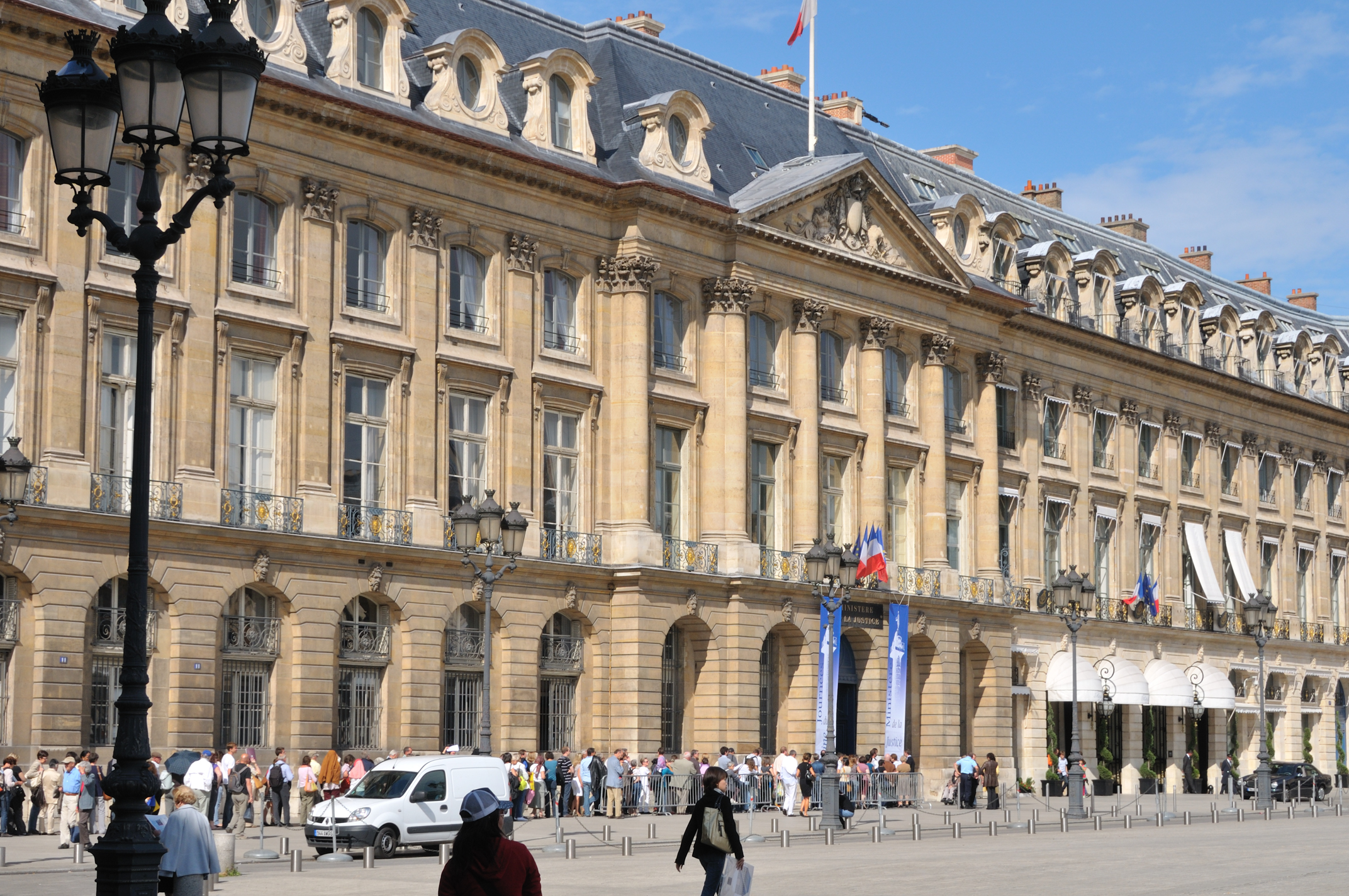
The French Ministry of Justice, Paris
French judge Jean-Michel Gentil has filed preliminary charges of 'abuse of a person in an impaired state' against former president Nicolas Sarkozy. The charges relate to  a €152,000 donation to his 2007 election campaign by Liliane Bettencourt, the ageing heiress of the sprawling L'Oréal cosmetics and beauty empire and the world's third-richest woman, with a net worth of €39 billion. Bettencourt, now aged 90, has been involved in a highly mediatised and long-running family feud over her fortune, and her failing mental health eventually led to her being put under judicial supervision at the request of family members.

Sarkozy entered the picture in 2008 when it was revealed that Bettencourt's chief accountant had alleged to police investigators that the heiress had authorised the Sarkozy election campaign fund payment after meeting him in 2007. The accountant also said that Sarkozy had visited the Bettencourt home several times and that each time he left with a brown envelope containing banknotes.

His UMP political party's offices were subsequently raided by judges looking for evidence of wrong-doing, and the next two years saw many witness statements being taken, several people being charged with various related offences, and efforts by judges to access Sarkozy's bank accounts are ongoing. 

The political reaction to the news was both instant and predictable. UMP politicians have embarked upon a virulent crusade against Gentil's decision, which is best summed up by former Sarkozy henchman Henri Guaino who told an interviewer that the judge's decision was "irresponsible", that he had "dishonoured the institutions" as well as "[French] justice." The accusations, he said, were "grotesque...unsupportable...unbelievable...intolerable". Meanwhile, Hollande and his socialist government have wisely decided to refrain from seeking to gain cheap political capital from the affair. Mind you, they can hardly do otherwise seeing as Hollande has just had to fire his Budget minister, Jérôme Cahuzac, after the latter was put under official investigation by a judge earlier in the week in relation to accusations that he has ferreted what could be illegally gained money out of the country and into a Swiss and other bank accounts.

More importantly though - and in a clear sign that the Sarkozy affair is set to be a viciously fought battle between Sarkozy and Gentil - it emerged yesterday that after being charged face to face by Gentil during the charge convocation the mood allegedly turned ugly, with Sarkozy leashing a veiled yet implicitly menacing threat, promising that "I'm going to take this matter further, make no mistake about it".

So the battle lines have been drawn. But these are no new battle lines, and there is no new front in the bitter and eternal war which has always pitted French presidents and other elites against a legal system which is doing no more than what is is mandated to do.

The unfettered independence of the French judicial system is enshrined within the French Constitution, but France is a country which is having many more problems putting the theory into practice than are many other western countries. Politicians and others in all countries try to influence their justice systems in one way or another, but the exceptionally porous nature of the relationship between the French justice system and political power is noteworthy.

Whereas it has not been uncommon in many other countries since the 70s to see politicians, including presidents and prime ministers, investigated and/or charged with alleged offences, and pay heavily for them, only one French president has ever been found guilty of an offence, with Jacques Chirac being handed down a 2-year suspended sentence for embezzling public funds after a trial which he did not attend due to illness.

There are two main reasons for this state of affairs, the first being that French presidents are immune from prosecution during their mandate. This means that they cannot be charged with alleged offences committed whilst in power until they are no longer president. And even if charges are eventually brought the French legal system permits endless legal challenges and procedurial objections to be lodged against charges as well as the possibility of endless appeals. The result is that cases become heavily diluted over time, that which makes proving guilt very difficult.

The second reason is direct political interference in ongoing cases. Judges can be removed from a case if a president fears they may be getting uncomfortably close to the truth, and governments often refuse to hand over pertinent documents and other evidence to investigating judges. Nobody here will forget how Alain Juppe's Justice minister, Jacques Toubon, tried to force a prosecutor back to France from his holiday in the Himalayas in order to persuade him to drop a case against a political ally (Paris Mayor Jean Tiberi) which had been brought by his adjoint. Toubon even ordered a helicopter to fly him down from the mountains! The prosecutor refused on this occasion. Toubon is also known for having ordered police and prosecutors who were on their way to raid the offices of another political ally to search them for evidence of fraud to turn back. He was obeyed.

Also, several high-profile cases of a very sensitive nature involving presidents - including Sarkozy - have been deliberately bogged down by endless presidential foot-dragging. They include the Taiwan frigates case, involving kickbacks to political leaders in exchange for Taiwan's agreement to buy French frigates. This case also involves the highly suspicious deaths of several witnesses. Another case is the Karachi bombing, in which a dozen French engineers were killed in the city whilst doing highly sensitive work for the government on submarines. This case has never really got off the ground either.

Sarkozy went even further whilst in power. He removed a number of inconvenient magistrates and prosecutors and used his friendship with famous Parisian magistrate Philippe Courroye to ask him to refuse to name an investigating judge for the Bettancourt case, which was making too much progress for his comfort. Courroye obeyed, much to the anger of magistrates and judges alike, and the case was thus dragged out. Sarkozy then went on to quite simply eliminate the functions of examing magistrates, thus strengthening his hold on the justice system. Other legislation was also introduced that would attempt to weaken the justice system, to the point where even his political allies were becoming afraid of the consequences of such actions.

But Courroye eventually fell into disgrace for reasons relative to other cases he was handling, and the investigation eventually got back on track after the alleged Bettencourt payments hit the headlines. Gentil was finally put in charge of the case, his work now made easier because Sarkozy is no longer president, and Sarkozy has now been charged.

This affair and the many revelations of meddling in the justice system it has led to has debunked the myth of an independent justice system in France. Sarkozy's meddling is the straw which broke the camel's back, and his being charged represents a clear victory for the many honest magistrates, judges and others who are trying to do their job despite heavy political interference. They deserve respect for their perseverence and courage.

But don't count on further improvements anytime soon. François Hollande promised to repeal and remove the system of presidential immunity from prosection during his election campaign, but now that he is in power he and his advisors have backtracked. The project as it stands today would only remove immunity for a limited number of civil offences - i.e. extremely minor cases, and even then they would be difficult to prosecute - but immunity shall remain for embezzlement, fraud and other criminal offences, that which renders the legislation toothless.

France's magistrates and judges may have won a victory by charging Nicolas Sarkozy, but the war for judicial independence in France is far from being won.

Tuesday, 19 March 2013

French appeal court was right to overturn créche firing of woman in an Islamic headscarf

Woman wearing a hijab
The French supreme appeals court has decided to overturn the 2008 decision of Parisian region créche Baby-Loup to fire a female employee because she wore a hijab - an Islamic headscarf - to work. The créche had dismissed her on the grounds of "the obligation of political, philosophical or confessional neutrality" as defined by its employee code of conduct rules, which is now de facto illegal as things stand.

In its judgement the court declared that "involving as it does a private créche" the employee's dismissal for 'serious professional misconduct' constituted "discrimination against religious principles" and that it must be declared "null and void". The judgement went on to state that a previous judgement by a court in Versailles which had declared the dismissal to be legal would also be overturned. The case will now be sent back to be judged before a court of appeal in Paris.

The court also found that the principle of 'laïcité' - the strict French version of secularity - could not be invoked to deprive "employees of private companies which do not supply a public service [...] of the protection of workplace legislation".

This judgement is a sensible one. France already has some of the strictest secular laws in the world, which ban the wearing of almost all religious insignia and clothing in public administrations, schools, hospitals and other state-run organisations. If France sees things that way so be it, but whether we agree with those laws or not French lawmakers are quite rightly at liberty to vote laws as they see fit as long as they do not transgress human and other rights.

And I even agreed with the banning of the burqua in public because I defend the principle that Western society relies on people being able to relate to others via the interpretation of facial expression.

But the idea of strict secularism imposing itself in the private sector is a step too far. Not only that, the court's decision is coherent with respect to a 2004 law which, although imposing strict laïcité in public schools, sensibly exempts private schools.

France is a country in which the state already pokes its nose into people's lives far more than is the case compared to what happens in other Western countries, but if private organisations in France were ever forced to bow to state-inspired ideology it would only be a matter of time before this ideology were imposed upon citizens in their own homes.

Saturday, 29 December 2012

Hollande's confiscatory '75%' and other milk the rich policies are getting their predictable commuppance

Hollande imitates a man of state
I think that rich people should be made to pay much higher taxes than they do now and that it's more than time that the markets, banks, hedge funds and all the rest of those money-spinning schemes for the rich should be taxed more, and I believe that tax rates on major companies (but not small ones) are outrageously low. Finally, I and most other people living in France would like to see Hollande succeed in taking concrete and efficient action to ensure these measures are taken.

But I also consider that waging an unfair, discriminatory and confiscatory - in other words illegal - fiscal war on any section of the population, including the rich, is not the way to go about taxing citizens in a democratic country, and nor is it efficient, as three recent examples have made more than obvious.

Hollande and his government have been ferociously intent on hastily and ill-preparedly trying, and failing for various reasons, to enact such laws ever since they came to power, and today saw Holland fail yet again as the French Constitutional Council threw out his most emblematic proposal, that of taxing the rich at 75%.

The Council rejected the measure for the very two reasons that most level-headed people have been saying it would for months. It was ruled to be confiscatory and thus illegal (the last time confiscatory laws of this amplitude were enacted was in World War Two during the Occupation of France, when they were applied to Jews only), and the Council also decided that it did not affect households equally because of its excessively one-sided effort to raise tax revenue. The council also refused a proposal for a 75% tax on complementary retirement pensions and two more minor measures because they too were confiscatory.

In other words, these proposed measures, which so pleased left-of-centre voters during the election campaign and thus got Hollande elected, have been reduced to political dust and the government will have to start all over again with a new and less discriminatory policy. That means we will have to wait for oh, four months at least whilst they go back to the drawing board and come up with something that is actually legal in constitutional terms.

Meanwhile, the rich will continue to pay more or less the current, much lower, rate of 45%. What a fiasco and what a waste of precious government time given the urgency of the need for tax reform. It was a ham-fisted effort to bludgeon discriminatory legislation into existence against all common sense which has already seen thousands of badly-needed tax euros disappear abroad with their owners. And the cherry on the cake is that even if they had gone through, these measures would have resulted in no more than a few hundred million euros of revenue - a drop in the ocean of the country's debt.

The second example of this administration's stubborn refusal to put its brain into gear before putting its mouth into motion concerns Minister for Industrial Renewal and polical loose cannon Arnaud Montebourg's attempt to renationalise a sprawling steelworking facility owned by the Mittal conglomerate and comprising several separate steel-related activities. He tried this on because he didn't like what the company's chairman was planning for the future, which he believed (wrongly as it turned out) involved massive layoffs.

This harebrained idea was also decided in great haste, essentially by Montebourg alone, and it too was judged to be potentially legally impossible because of its spoliatory and discriminatory nature. Not only that, both Hollande and PM Jean-Marc Ayrault were warned that it would send out a disastrous message to foreign investors at a time when France desperately needs them, so they put the kibosh on it and did what they should have done in the first place, which was to come to an agreement with the company's owners. Montebourg was furious and is now being touted as a possible contender for replacement in the next government reshuffle, particularly if he continues to decide policy alone and on-the-hoof, which is probably why we haven't heard a peep from him since then.

The third example involves housing the homeless, particularly during winter, and thus it was that Minister of Territorial Equality and Housing Cécile Duflot woke up one morning a few weeks ago to announce to a waiting world that she was going to implement a policy of government requisition of empty houses and business premises which have been empty for over 6 months and put homeless people in them. Brilliant! Except that it wasn't.

Most of this kind of property is owned by the rich or big companies, and as French law only allows this kind of measure in cases of 'national emergency' it soon became clear that it wasn't going to fly and that there may even be grounds under these conditions for the buildings' owners to contest the decision on the grounds that this situation is not a 'national emergency' and could thus be ascertained to be, yes, you guessed, spoliation. Again.

The government also realised, weeks after announcing the plan, that it was fatally flawed in many other areas. These properties would have needed massive investment (particularly office premises) to adapt them to human habitation, many of them are not situated in areas which are suitable for those who would live in them (too far from work sources and other facilities), the plan would have necessitated a whole infrastructure of administrative staff to oversee the project and select candidates etc and, most importantly, the procedure as it stands takes months. Even housing associations said that this was not a substitute for a housing policy.

All of which explains why a humiliated Duflot was forced to announce yesterday that she was abandoning the idea just weeks after coming up with it because the procedure would take too long as it couldn't be shortened without being unconstitutional and that "no senior politician can break into a building with a crowbar. The state is subject to the rule of law."

Another climbdown, another reversal, another waste of time which has pushed back efforts to help the homeless and another reason to think that this government seems incapable of creating policies which oblige the better off to help which are not totally over the top, illegal, and immoral.

It's high time this government abandoned its ideological hit-the-rich attitudes and began legislating not to please popular sentiment for relatively paltry sums of tax revenue but in order to do what is possible, as in legal. This government is wasting far too much preciously-needed time in its vain (in both senses of the word) efforts to legislate the impossible.

My dad used to say that "you're better off with 75% of something than 100% of nothing."

He was right.